
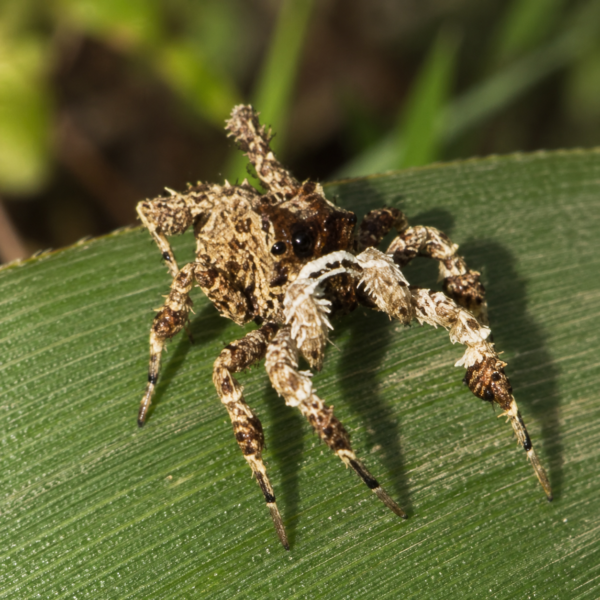
portia sp.
€ 30,00
the Portia sp. is known worldwide as the “smartest spider in the world”. This jumping spider is a specialist in hunting other spiders and uses complex strategies to overpower its prey.
1. housing
- Enclosure type: A vertically oriented enclosure of approximately 15x15x25 cm is sufficient. Because they move relatively slowly and often lie in wait motionless for hours, they do not require enormous space.
- Decoration: mimics a natural environment with many twigs, dry leaves, and fine-meshed structures. Portia often builds a messy web itself (unique for a jumping spider) that serves as a resting place and base of operations.
- Light: Good visibility is essential for their hunting behavior. Provide sufficient daylight or a mild LED lamp, but avoid direct sunlight to prevent overheating.
2. climate
- Temperature: Most species (such as P. fimbriata or P. labiata) thrive at temperatures between 22°C and 26°C. Normal room temperature is often sufficient.
- Humidity: Keep the humidity around 60-70%. Lightly mist the enclosure (preferably the walls) two to three times a week. They are less sensitive to dryness than Hyllus, but do need moisture to drink.
3. Nutrition (Crucial point)
- Diet: Unlike other jumping spiders Portia spiders prefer other spiders, but with us they also accept flies
- Food choice: You can feed them small house spiders, cellar spiders, or other jumping spiders. If you do not have spiders on hand, they sometimes accept flies or small crickets, but their hunting instinct is fully geared towards imitating vibrations in the webs of other spiders.
- Frequency: They have a very slow metabolism. One prey item per week is often more than enough.
4. Behavior
- Hunting technique: It is fascinating to watch. They tap on another spider's web to mimic prey or a mating partner, thereby luring the web's occupant into a trap.
- Movement: They often move jerkily, like a leaf moving in the wind, to remain unnoticed.
5. Breeding and handling
- Handling: Not recommended. Portia is small and fragile. Furthermore, handling disrupts their complex observational behavior.
- Breeding: This is a challenge, because they tend to eat their partner if mating does not go perfectly.
Related products
-

Stegodyphus lineatus
€ 20,00 -

hyllus diardi
€ 25,00